

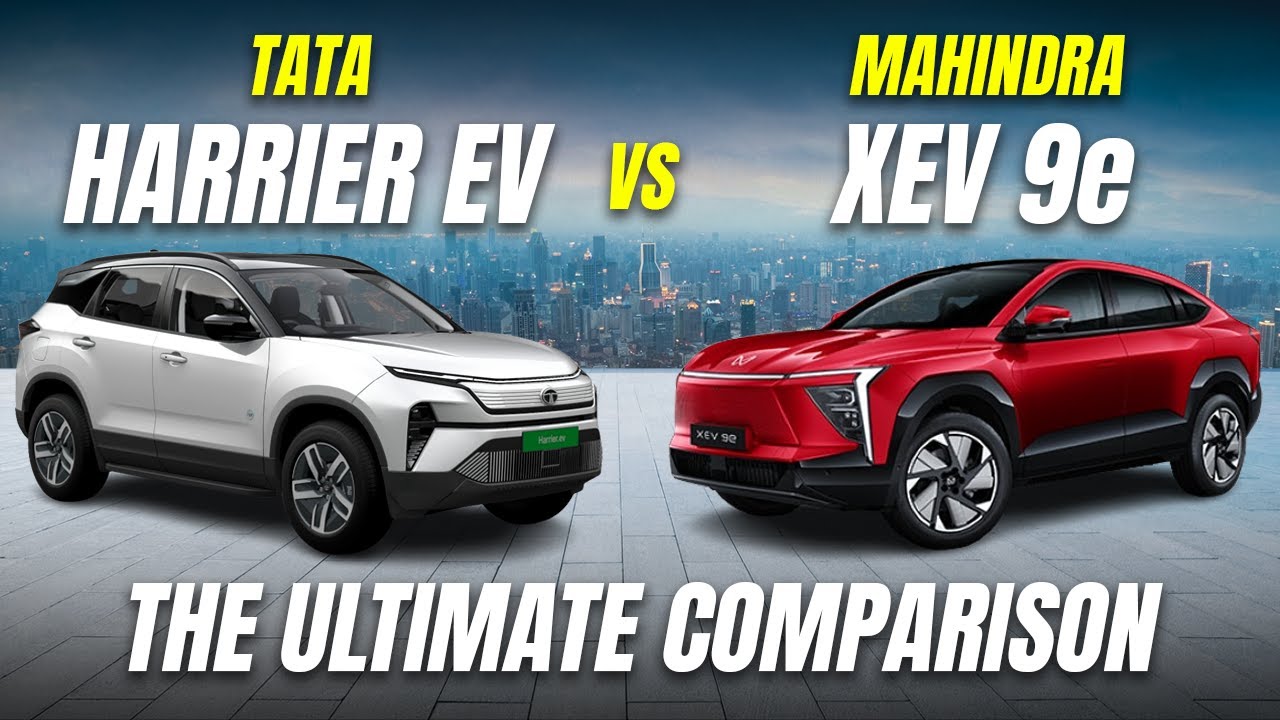
Tata Harrier EV is a more traditional, comfortable, and quicker-accelerating SUV, while the Mahindra XUV.e9 is a more radical, tech-focused, coupe-styled vehicle offering superior real-world range and cargo space.
Performance and Range
The Harrier EV (AWD version) is quicker in acceleration, while the XUV.e9 offers a better real-world driving range.
- Tata Harrier EV (dual-motor AWD)
- Power & Torque: Produces a combined 313hp and 504Nm.
- Acceleration: Accelerates from 0-100kph in 6.74 seconds.
- Real-world Range: Achieves an average real-world range of approximately 401km.
- Mahindra XUV.e9 (single-motor RWD)
- Power & Torque: Produces less power than the AWD Harrier but is 134kg lighter.
- Acceleration: Slightly slower to 100kph than the AWD Harrier EV, but reaches a higher top speed.
- Real-world Range: Capable of delivering a superior average real-world range of 456km.
These analyses weigh the comfort-focused, traditional SUV approach of the Tata Harrier EV against the bold, tech-centric, and sportier characteristics of the Mahindra XUV.e9
The Harrier EV is generally considered the more comfortable option, while the XUV.e9 offers a sportier driving experience.
- Tata Harrier EV
- Ride Quality: Features well-absorbent and pliant ride quality, easily managing different kinds of roads.
- Handling: The controls are relatively heavy, with a less connected steering feel compared to the XUV.e9.
- Mahindra XUV.e9
- Ride Quality: The ride is stiffer, and while it handles well for its size, some body movements might be felt by passengers.
- Handling: Offers a more direct, quicker steering input and feels nimbler, making for a more enjoyable driving experience on corners. It features semi-adaptive dampers linked to drive modes.
Design and Practicality
The two vehicles follow different design philosophies, impacting their interior space and features.
| Feature | Tata Harrier EV | Mahindra XUV.e9 |
|---|---|---|
| Design | Conventional SUV styling, rugged, and muscular. | Bold, radical, and futuristic coupe-like design. |
| Boot Space | 502 liters, with a raised boot floor. | Generous 663 liters, with a flat load bay. |
| Frunk (Front Trunk) | Small 35 liters (AWD version). | Large 150 liters, capable of storing several bags. |
| Rear Seat Comfort | Fixed rear seats with less under-thigh support. | Reclining rear seats for enhanced comfort on long drives. |
Features and Technology
Both vehicles are feature-rich, but offer different “party tricks” to stand out.
- Tata Harrier EV: Features include an HD IRVM camera projection, a “boss” mode for the front passenger seat, off-road assist, and six terrain modes.
- Mahindra XUV.e9: Highlights a striking three-screen dashboard layout (including a dedicated passenger screen), single-pedal drive mode, and auto-park assist.
These two homegrown electric SUVs we’ve brought together follow two very different approaches. On one side is the new Tata Harrier EV, built on the familiar and mature Harrier template. On the other is the Mahindra XEV 9e, a mould-breaking and radical EV. Both hover around the Rs 30 lakh mark, both pack in the latest features and tech, and both boast claimed ranges of over 600km. So, which one makes the stronger case?
The Harrier EV can be had with a single motor (rear) setup with either a 65kWh or 75kWh battery – the former priced between Rs 21.49 lakh and Rs 23.99 lakh, and the latter between Rs 24.99 lakh and Rs 27.49 lakh. The range-topping dual-motor version (our test vehicle) comes with the larger battery and is priced at Rs 28.99 lakh.
The Mahindra XEV 9e, on the other hand, is available only in a single (rear) motor avatar, but it also gets two battery options – 59kWh and 79kWh. The smaller version is priced between Rs 21.90 lakh and Rs 27.90 lakh, while the larger version’s price range is Rs 26.50 lakh-30.50 lakh. For this test, we’ve picked the absolute top variants of the two.
Tata Harrier EV vs Mahindra XEV 9e exterior design and engineering
XEV 9e is longer and has a longer wheelbase, but the Harrier EV is wider and taller
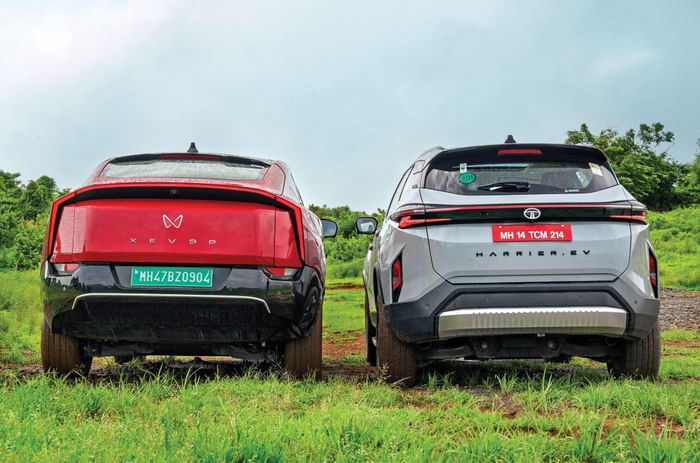
The Mahindra has a swoopy coupe-like design while the Tata has a more conventional SUV tailgate.
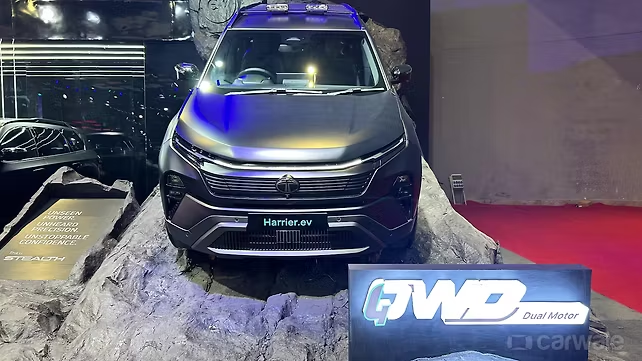
The Harrier EV resembles its ICE sibling – well-proportioned, muscular and handsome. But don’t let its familiar persona deceive you. While it does share its ‘top hat’ and some interior bits with the ICE version, beneath the skin, it’s a completely re-engineered product with a new floorpan, suspension and EV-specific hardware. And while the ICE is front-wheel driven, the Harrier EV is primarily rear-wheel driven. Our test vehicle is the dual-motor version, with one motor driving the rear wheels and another driving the front, giving the Harrier EV all-wheel-drive capability.
The Mahindra XEV 9e, meanwhile, plays a very different game. Where the Tata follows a conventional design language, the XEV’s styling is bold, radical and futuristic, and is bound to turn heads. The XEV 9e is longer than the Tata, and its wheelbase is longer too; however, it is the Harrier EV that’s wider and taller in this company.
| Tata Harrier EV vs Mahindra XEV 9e specifications | Tata Harrier EV AWD | Mahindra XEV 9e |
|---|---|---|
| Length (mm) | 4607 | 4789 |
| Width (mm) | 2132 | 1907 |
| Height (mm) | 1740 | 1694 |
| Wheelbase (mm) | 2741 | 2774 |
| Front/rear boot capacity (litres) | 35/502 | 150/663 |
| Tyre size | 245/55 R19 | 244/55 R19 |
| Battery capacity (kWh) | 75 | 79 |
| Power (hp) | 158 (front), 238 (rear) | 286 |
| Torque (Nm) | 504 | 380 |
| Drive layout | AWD | RWD |
Tata Harrier EV vs Mahindra XEV 9e interior space and comfort
Both are feature-rich, but the XEV 9e gets features like reclining rear seats and an HUD
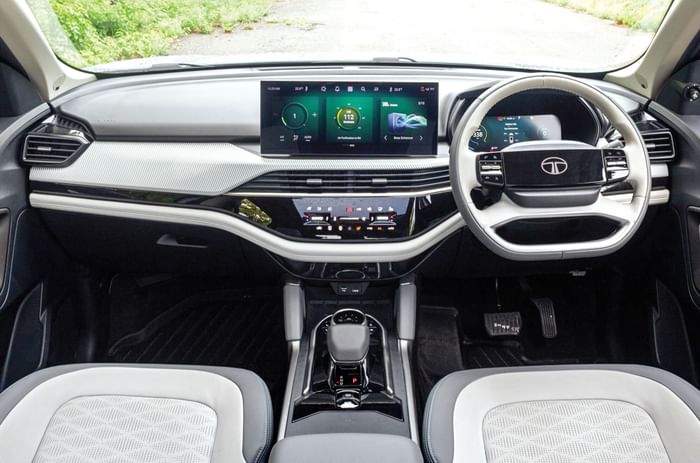
A highlight of Harrier EV’s interior is the crisp 14.5-inch Samsung QLED touchscreen.
Step into the Harrier EV, and you’re greeted by a wide, horizontally laid-out dashboard and a crisp 14.5-inch Samsung QLED touchscreen. The user interface is intuitive, the 360-degree camera feed is sharp and lag-free, and there’s also a Land Rover-style digital inner rear-view mirror, which doubles up as a dash camera. The camera feed offers natural depth perception, but the mirror surface does show reflections at times. Further improving the user experience are touch-based shortcut keys, as well as physical switches for temperature and front-seat ventilation.
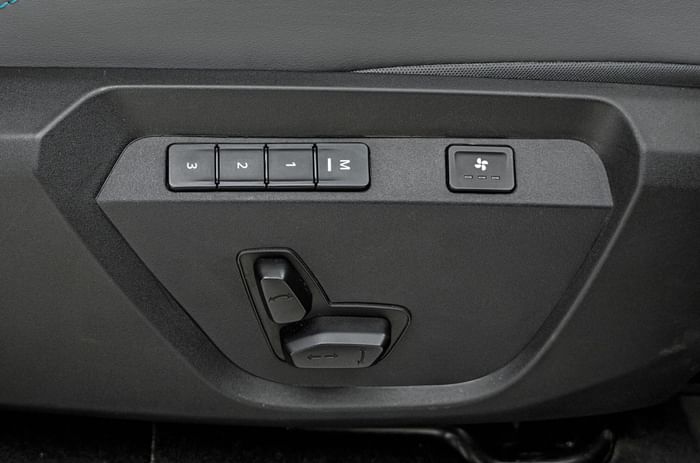
Harrier EV’s driver’s seat gets ventilation and a memory function.
However, Tata hasn’t fully ironed out some long-standing ergonomic flaws: the wireless phone charger remains fiddly, the wide centre console fouls with taller drivers’ knees, and thigh support is inadequate on the front seats. Rear passengers fare better with a flat floor, generous space and winged headrests, though, again, thigh support is lacking.
The XEV 9e’s cabin immediately grabs your attention thanks to the brighter upholstery and its signature three-screen layout. The front seats are more supportive than the Tata’s, but on the Mahindra, seat ventilation is hidden within touchscreen menus, which is rather inconvenient, especially on the move. In fact, the whole infotainment system is very confusing, and users will need to invest time to get acquainted with it. Also, using the steering wheel’s haptic buttons inadvertently triggers the horn.

XEV 9e interior’s three-screen layout is defintely eye-catching.
In the back, wide-opening doors make ingress easy, and space is generous, although tall passengers may find headroom compromised. What’s nice is that the flat seat base and recline function enhance comfort, and unlike in the Harrier (which gets only two), all three passengers get individual adjustable head restraints.
As far as storage goes, the Mahindra’s luggage-carrying ability is leagues ahead, with a generous 663-litre boot space, a flat load bay and a surprisingly large 150-litre front-loading area. The Harrier EV, on the other hand, has a smaller 502-litre boot, a raised boot floor and a small 35-litre front-loading area (the 2WD version, though, offers up to 67 litres of space).
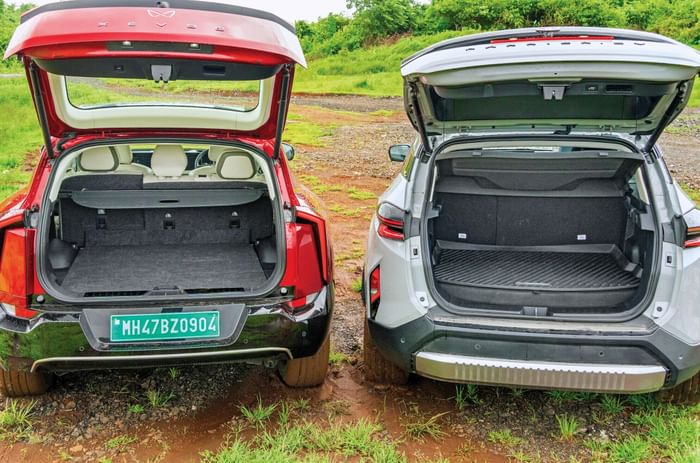
XEV 9e’s boot holds up to 663 litres of luggage compared to the Harrier EV’s 502-litre capacity.
Tata Harrier EV vs Mahindra XEV 9e performance
Harrier EV AWD accelerates quicker, but XEV 9e reaches a higher top speed
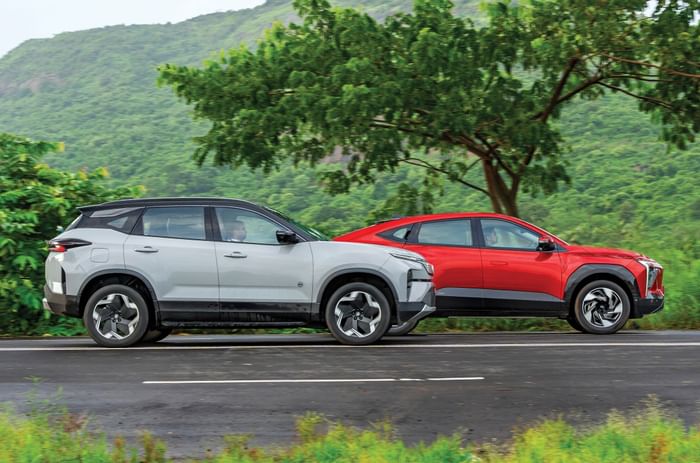
On paper, the Harrier EV is the powerhouse, with its dual motors producing a combined 313hp and 504Nm. Under normal driving conditions, in the interest of efficiency, the Harrier EV is rear-wheel driven for the most part, and only when the system detects slippage or the driver accelerates aggressively does the front motor come to life. Power delivery is very linear, and on account of its sheer 2.3-tonne weight, the Harrier EV masks its speed, hence acceleration doesn’t ‘feel’ sudden or electrifying. Make no mistake, though, the Harrier EV is rapid – it accelerates from 0-100kph in just 6.74 seconds, 0.71 seconds quicker than the 134kg lighter XEV. While the Harrier is marginally quicker, it tops out at 180kph, whereas the Mahindra maxes out at a little over 200kph.
| Tata Harrier EV vs Mahindra XEV 9e performance | Harrier EV | XEV 9e |
|---|---|---|
| 0-20kph (s) | 1.26 | 1.42 |
| 0-40kph (s) | 2.43 | 2.78 |
| 0-60kph (s) | 3.62 | 4.14 |
| 0-80kph (s) | 4.93 | 5.59 |
| 0-100kph (s) | 6.74 | 7.45 |
| 0-120kph (s) | 9.19 | 9.86 |
| 80-0kph braking distance (m) | 24.36 | 25.88 |
| 80-0kph braking time (s) | 2.23 | 2.64 |
| 80-20kph Level 1 regen braking distance (m) | 293.26 | 297.24 |
| 80-20kph Level 2 regen braking distance (m) | 161.42 | 174.51 |
| 80-20kph Level 3 regen braking distance (m) | 130.64 | 134.95 |
Tata Harrier EV vs Mahindra XEV 9e ride comfort and handling
XEV 9e gets a single-pedal drive mode, though both have three levels of brake regen
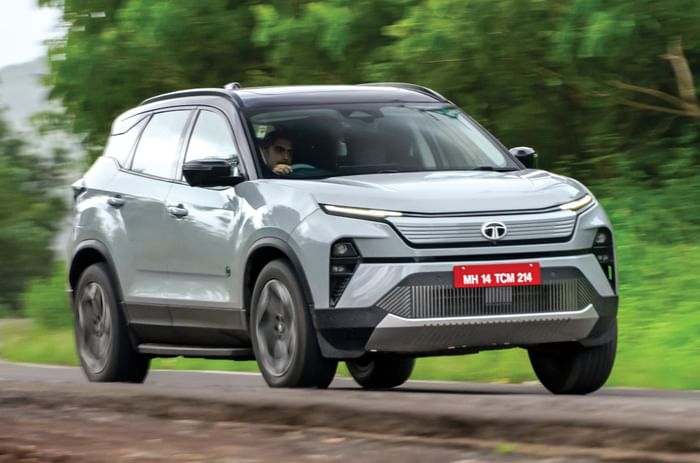
On the highway, the Tata EV tends to feel floaty at the rear.
The Harrier EV also impresses with sharp steering and strong grip, thanks to its all-wheel-drive system and taut chassis that result in confidence-inspiring body control. Low-speed ride quality is exceptionally absorbent; however, it tends to feel floaty, particularly from the rear, as you up the pace on highways.
The XEV 9e’s single rear-mounted motor produces 286hp and 380Nm, which is much lower than the Harrier EV’s. Still, the XEV 9e’s motor performs more aggressively and feels a bit more effortless and lighter on its feet. But what truly elevates the drive experience is its variable gear ratio steering, which is lighter and more precise – paired with a tight 5-metre turning radius, it is astonishingly manoeuvrable for its size. Semi-adaptive dampers linked to drive modes superbly balance ride comfort with handling, and the XEV feels surprisingly nimble and confident for its size.
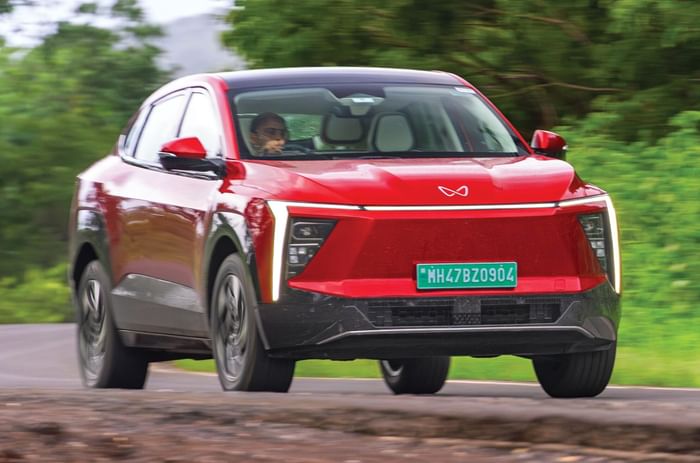
XEV 9e is quite manoeuvrable for its size.
Both SUVs get drive modes that influence the powertrain and steering. In the XEV 9e, the drive modes also alter its semi-adaptive dampers, which noticeably stiffen in ‘Race’ mode. Furthermore, both cars get terrain modes, which alter throttle response and ESP settings to enhance traction while driving in wet, sandy, muddy or snowy conditions.
As far as regenerative braking goes, both cars get multiple settings, including one to turn it off completely. In our tests, the Harrier EV decelerated from 80-20kph in a shorter distance across the three regen modes than the XEV 9e, showing that it has relatively stronger regen braking. The Mahindra, though, offers a single-pedal mode (a much more aggressive setting), which brings the vehicle to a complete halt.
In our braking test from 80kph, it was the Harrier that stopped in a shorter distance despite its weight; however, as far as brake pedal feel goes, the Tata leaves a lot to be desired.
Tata Harrier EV vs Mahindra XEV 9e range and charging
XEV 9e 79kWh has more real world range than the Harrier EV AWD
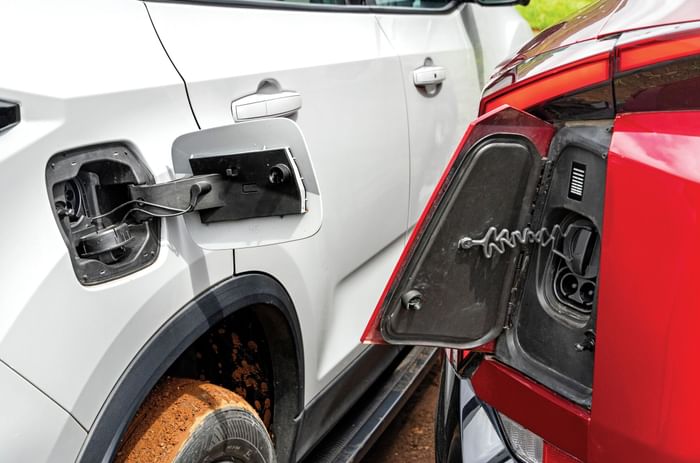
A 7.2kW charger is an optional extra for both.
To verify whether these cars can match their manufactured claimed range figures of over 600km, we put both cars through our real world range test. Interestingly, the Harrier’s city efficiency of 5.5km/kWh is slightly higher than the XEV’s 5.4km/kWh; however, out on the open road, the Mahindra’s 6.2km/kWh efficiency is far greater than the Harrier’s 5.2km/kWh. Overall, when extrapolated, it is the XEV 9e that is capable of delivering 456km (average) on a single charge, more than the Harrier EV’s 401km.
As far as DC fast charging goes, the Mahindra’s 409V architecture accepts up to 175kW, while the Harrier’s 377V system maxes out at 107kW. What that means is, on a 120kW or faster charger, the XEV will ideally top up its larger 79kWh battery faster than the Harrier EV. Another point to note is that the Harrier EV only gets a 7.2kW on-board charger, while the Mahindra gets a 11.2kW unit for quicker AC fast charging. Notably, both manufacturers give buyers the option to purchase an AC fast charger at an additional cost – a 7.2kW unit for Rs 49,000 in the Tata, and in the XEV’s case, Rs 50,000 (for 7.2kW) and Rs 75,000 (for 11.2kW).
| Tata Harrier EV vs Mahindra XEV 9e range and efficiency | Tata Harrier EV | Mahindra XEV 9e |
|---|---|---|
| City efficiency | 5.5km/kWh | 5.4km/kWh |
| Highway efficiency | 5.2km/kWh | 6.2km/kWh |
| Range (average) | 401km | 456km |
Tata Harrier EV vs Mahindra XEV 9e price and verdict
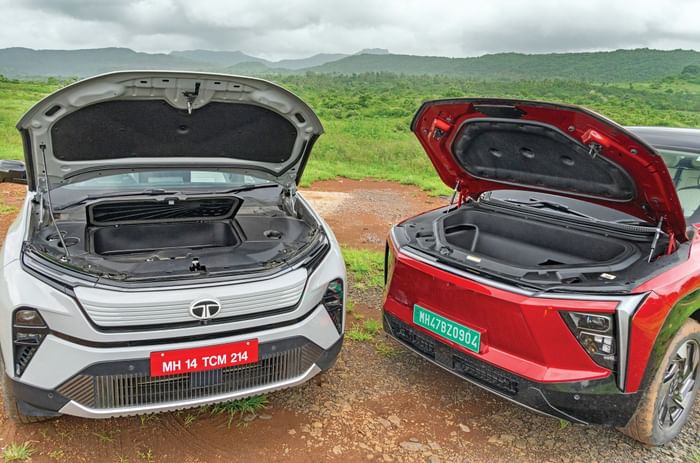
The XEV 9e’s 115-litre frunk is much larger than the Harrier EV AWD’s 35-litre one.
It’s remarkable how far both these homegrown brands have come along in the EV space. The Tata Harrier EV looks stylish, has the features you’d expect, rides well and drives in a mature manner. Additionally, it scores strongly on value, with even the AWD version priced lower than the Mahindra. So, it comes across as a sensible, well-rounded choice.
Leave a Reply